Welcome to ITD140
What you'll learn on this page
- What this course will and won't cover
- How to succeed in an async ML course
The 30-second pitch
Machine learning is the part of computer science where, instead of writing the rules yourself, you give a computer a pile of examples and let it figure out the rules. By the end of this course, you'll be doing exactly that — feeding data to scikit-learn and getting back predictions that actually work.
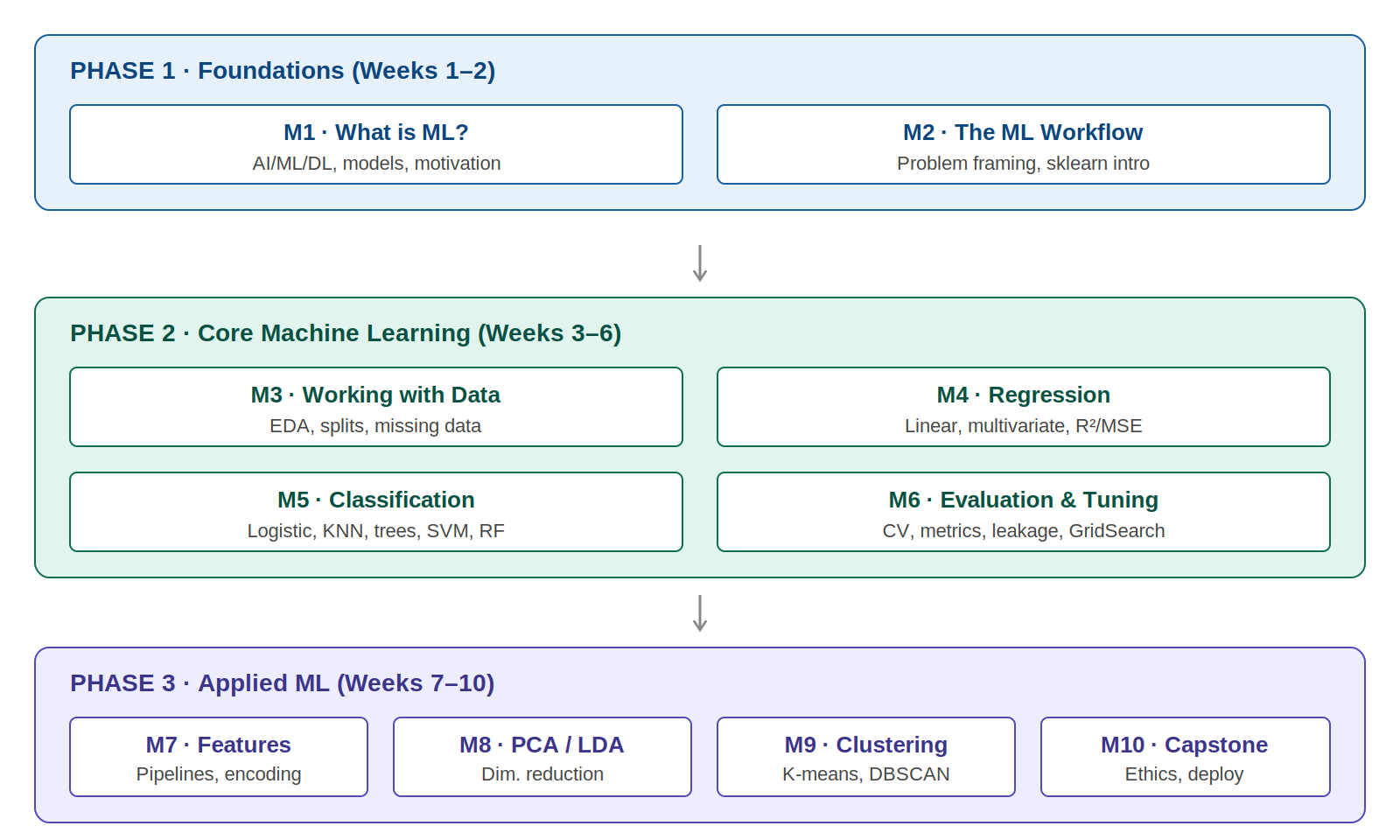
The 8/10-week roadmap
How to succeed in an async course
Asynchronous doesn't mean self-paced. Each week's content opens Monday and the final deliverable closes Sunday. Three habits separate students who thrive from those who don't:
- Pick fixed work times. "Tuesday 7–9pm and Saturday morning" beats "I'll do it whenever." The brain rewards routine.
- Run the code, don't just read it. Every code snippet in this course is meant to be executed. Reading code is like watching someone exercise — it's not the same as doing it.
- Ask questions in the discussion board, not over email. If you have a question, three other students probably do too. Posting publicly helps everyone.
Tip — The single best thing you can do this week
Get Python or Google Colab working now. The students who fall behind are almost always the ones who postpone setup. The course's Module 1 assignment is intentionally tiny so you'll discover environment problems early.
Get Python or Google Colab working now. The students who fall behind are almost always the ones who postpone setup. The course's Module 1 assignment is intentionally tiny so you'll discover environment problems early.
Check your understanding
- Which phase of the course do you think will be the hardest, and why?
- What's your plan for fixed weekly study times?