What Is ML, AI, and Deep Learning?
- How AI, ML, and deep learning relate to each other
- Why these terms are often confused — and how to talk about them precisely
- What "the model" actually is
Why this matters
In job postings, news articles, and conversations with non-technical colleagues, "AI," "machine learning," and "deep learning" get used interchangeably. They aren't the same thing. Mixing them up costs you credibility, and worse, it leads to choosing the wrong tool for a problem.
The nested relationship
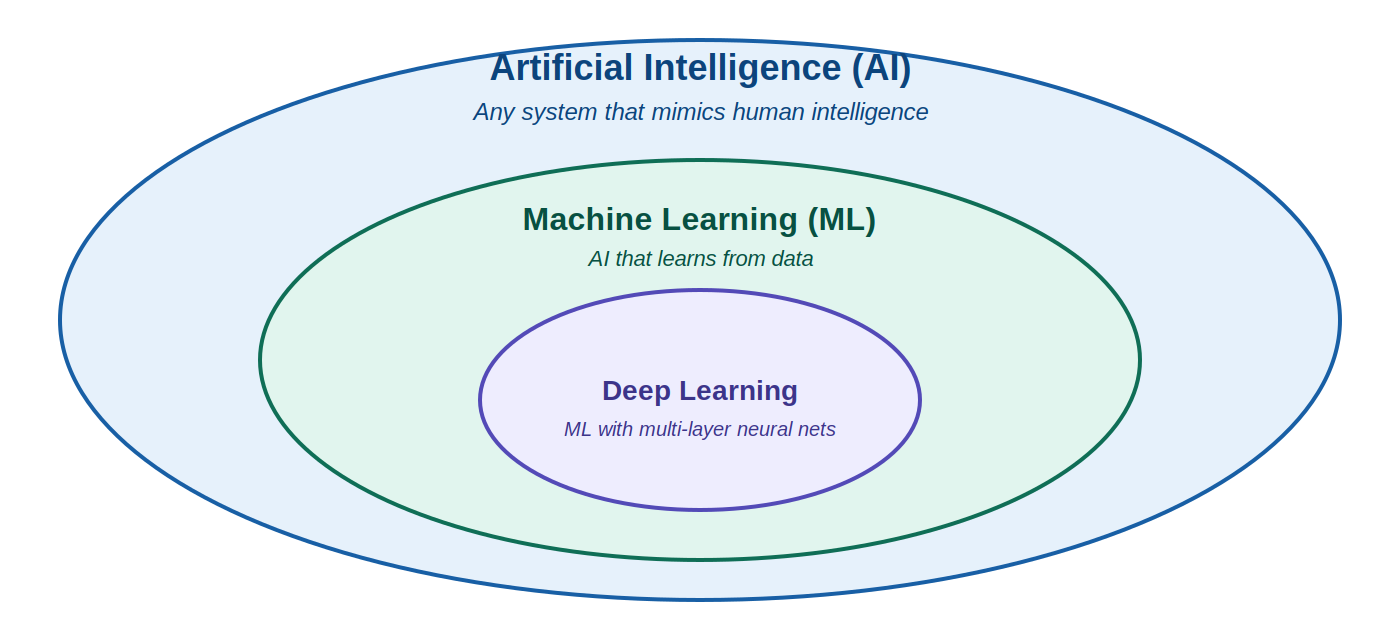
AI is the umbrella. ML is a branch. Deep learning is a sub-branch of ML.
Definitions, in plain English
| Term | Definition | Example |
|---|---|---|
| AI | Any computer system that performs tasks normally requiring human intelligence — reasoning, perception, decision-making. | A chess engine, a thermostat that "learns" your schedule, Siri. |
| ML | A subset of AI where the system learns the rules from data instead of being explicitly programmed with them. | A spam filter trained on a million labeled emails, Netflix's recommendation engine. |
| Deep Learning | A subset of ML using neural networks with many layers. Particularly strong on images, audio, and language. | Face recognition, ChatGPT, self-driving car perception. |
All deep learning is machine learning. All machine learning is AI. But not all AI is machine learning -- a rule-based chess engine is AI, but it doesn't learn. A traffic light controller running an "if-then-else" decision tree someone hand-coded is AI, but not ML.
What is "the model"?
You'll hear the word model constantly in this course. A model is just the rules the machine has learned. After training, the model is a small file (sometimes a few kilobytes, sometimes a few gigabytes) that takes new inputs and produces predictions.
You'll see it from a few different angles this week:
- In Page 1.4, your "model" is the formula (y = 1.8x + 32) -- just two numbers,
mandb, which are the parameters. - Later, your "model" might be a decision tree with 50 branches. That would be roughly 100 parameters.
- For ChatGPT (version GPT-4), the "model" is roughly 1.8 trillion numbers.
The size and complexity vary wildly, but the function is the same: input → model → prediction.
Watch: What is machine learning? (5 min)
Oxford Sparks: "What is Machine Learning?" — a 4-minute, jargon-free overview.
People often say "AI" when they mean ML, and "ML" when they mean deep learning. In casual conversation, fine. In a job interview, on a project plan, or in a research paper, be precise. The wrong word can imply you'd use a sledgehammer on a thumbtack.
Check your understanding
- A spreadsheet macro that auto-fills cells based on patterns you've shown it -- is that AI, ML, or neither? (Hint: think about whether rules were explicitly programmed.)
- If a model is "trained on 50,000 photos," is that more likely traditional ML (e.g. decision tree or kNN) or deep learning (e.g. large neural network)?
- True or false: A chess engine is always AI, but only sometimes ML.
Show answers
- It's ML -- the macro learned from your examples without explicit rules.
- Both, but if it's photos specifically, deep learning is more likely (image data is where deep learning dominates).
- True -- Deep Blue (1997) was AI but rule-based. AlphaZero (2017) was AI and ML. [see Which is greater? The number of atoms in the universe or the number of chess moves? | The big question]